

The difference between a hot tub you'll use every week for 15 years and one that becomes a patio obstacle within two starts with five things: how the jets are engineered, how the shell is built, how it handles energy, how the water stays clean, and whether the seats fit your body. In 2026, you can buy a spa for $1,500 or $16,000, and price alone won't tell you which of those five things the manufacturer got right.
Jet quality vs. jet count: why more isn't always better
Every hot tub ad leads with the jet count. It's the biggest number on the spec sheet, and manufacturers know you'll compare it. But here's what the jet count doesn't tell you: the size of those jets, what type they are, where they're pointed, and whether they're actually targeting muscle tissue or just blasting water at the shell.
Budget spas in the $1,500-$3,000 range from places like Costco or Home Depot often pack 40 or 50 tiny jets into the shell to inflate that number. They're all the same size, all the same type, and they share one pump. When you turn them on, the water pressure divides across every jet and you get a weak, diffuse spray that doesn't do much for a sore lower back.
How many jets should a good hot tub have?
A well-designed spa uses a mix of jet sizes and types: large rotating jets for broad muscle groups, smaller pulsating jets for targeted pressure, directional jets you can aim, and foot jets for reflexology zones. Passion Spas worked with physiotherapists to position each jet on soft tissue, the way a massage therapist would, avoiding bone and focusing on the muscles and tendons that actually benefit from hydrotherapy.
The Recharge has 34 jets and delivers a more therapeutic massage than many 60-jet competitors, because every jet was placed with a purpose. The Solace at 58 jets adds Aqua Rolling Massage, where water pushes upward through a sequence of jets in the bucket seat, working from your lower back to the base of your neck. Passion Spas engineered that system to replicate the rolling pressure of a masseuse's hands, and it genuinely feels different from a standard jet arrangement.
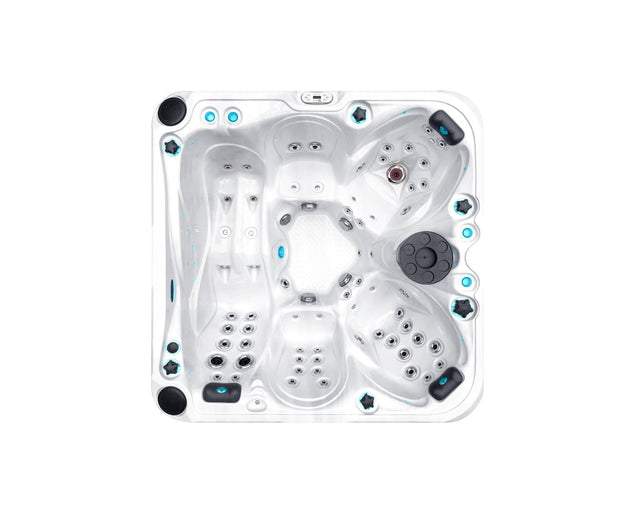
Solace
Insulation and energy: what actually keeps your power bill low
Every brand claims good insulation. The question is what sits between the shell and the cabinet, and how the spa manages heat when the heater isn't running.
There are three common approaches. Partial foam insulation sprays foam only on the shell's back, leaving the equipment bay exposed. Full-foam fills the entire cabinet, which retains heat well but makes plumbing repairs expensive. Triple-layer insulation, used in Passion Spas, wraps the shell, lines the cabinet walls, and seals the base with an Everlast floor support, creating a thermal envelope that traps heat without entombing the plumbing.
What is the most energy-efficient hot tub?
Insulation keeps heat in. But Passion Spas went a step further with Hybrid Heating, which actually creates heat that would otherwise be wasted. Every circulation pump generates friction as it moves water, and that friction produces warmth. In a conventional spa, that warmth dissipates into the equipment bay. Hybrid Heating redirects it back into the water, supplementing the electric heater and reducing its workload. In the Texas climate, where ambient temperatures already do half the job in summer, that combination keeps monthly electricity between $30 and $60.
Another thing to check: does the spa have a dedicated low-wattage filtration pump, or does it use the main massage pump for filtration? A shared pump draws significantly more power every time it cycles and wears out faster. A separate filtration pump runs continuously on minimal electricity, keeping your water clean without the energy penalty.
Shell construction and what's underneath it
The shell is the part you see and touch. What's underneath it determines whether you're still enjoying this spa in 2041 or shopping for a replacement in 2029.
Quality spas use vacuum-formed acrylic reinforced with hand-laminated vinyl-ester resin. That layering process creates a rigid, non-porous surface that resists cracking, UV damage, and chemical staining. Underneath, the support structure should be pressure-treated wood or engineered synthetic framing, not lightweight metal that corrodes in humid environments. Texas humidity is relentless, and anything that can rust will.
The Joy is a good example of what this looks like in practice: hand-laminated acrylic shell, synthetic support structure, Everlast floor support enclosing the entire base, and an EasyClean Shield coating on the acrylic surface that prevents oils and dirt from bonding. That's the kind of construction that keeps an owner in the UK still ordering original replacement jets years after purchase, because the shell and frame are still in perfect condition.
Budget tubs often use rotomolded polyethylene, similar to the material in coolers. It's cheap, lightweight, and fades in direct sunlight within a year or two. If the shell feels like thick plastic rather than a smooth, glossy surface, walk away.
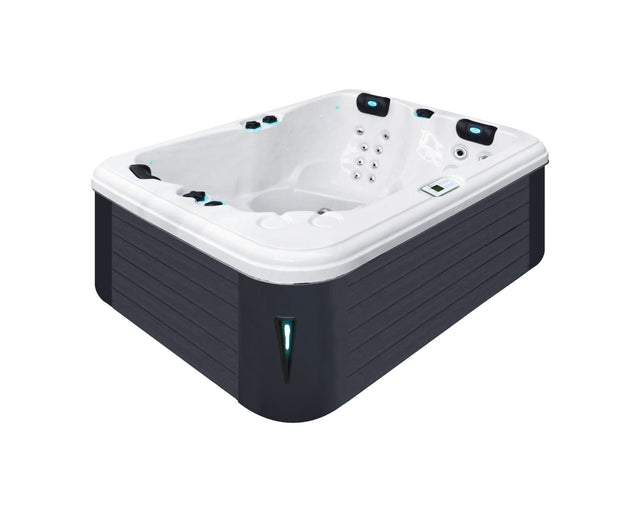
Renew
Water care and filtration: the maintenance factor
Nobody buys a hot tub because they love testing water chemistry. The best filtration system is one that does most of the work for you.
The single most important question to ask about any spa: does the filtration pump run independently of the massage jets? In a spa with a shared pump, filtration only happens when you manually turn the jets on or when a timed cycle kicks in. Between those cycles, the water sits still. Bacteria, body oils, and debris accumulate. You compensate with more chemicals, more frequent filter cleaning, and more headaches.
A dedicated filtration pump runs around the clock, continuously pulling water through the filter regardless of whether you're using the spa. That constant circulation is the foundation of clean water. On top of that, the Synergy Water Maintenance System in Passion Spas adds ozone sanitation, which breaks down organic contaminants without the chlorine smell and skin irritation. The result is water that stays clear longer, requires fewer chemicals, and needs less of your time. Most owners report spending about 10 minutes a week on water care.
The walk-on safety cover plays a role too: it keeps debris, UV, and rainwater out between uses, reducing filtration workload and keeping temperature stable.
Seating and size: matching the spa to your life
A spec sheet says "seats 7." What it doesn't say is whether those seven people will be comfortable, or whether one person's jets blast into another person's back.
| Model | Seats | Jets | Best for | Price |
|---|---|---|---|---|
| Sparkling | 4 | 16 | Small patios, 120V plug-and-play | $3,995 |
| Renew | 3 | 40 | Couples, compact spaces | $5,499 |
| Recharge | 5 | 34 | Small families, round design | $5,999 |
| Relax | 7 | 36 | Families, dual loungers for all heights | $6,495 |
| Solace | 5 | 58 | Massage enthusiasts, Aqua Rolling seat | $8,605 |
| Joy | 7 | 70 | Entertaining, bucket seats + sound system | $9,995 |
| Excite | 7 | 105 | Full-size hydrotherapy, bench + bucket mix | $12,995 |
Seat design matters as much as seat count. Passion Spas collaborated with recliner industry engineers to shape the seat contours and lumbar support, which is why the loungers in the Relax actually cradle your lower back instead of forcing you into a flat, slippery position. The two loungers in the Relax are different heights, designed so a 5'4" and a 6'2" person both find their comfortable spot without adjusting anything.
If you're buying for entertaining, sit in the spa before you buy. Imagine four adults with drinks. Is there a place to set a glass? Can everyone talk without shouting over the jets? Does the LED lighting create the kind of atmosphere that makes people want to stay outside? These details separate a spa that gets used twice a month from one that becomes the center of your backyard life. At Fonteyn Houston's warehouse, you can sit in every model on the floor and feel the difference for yourself.
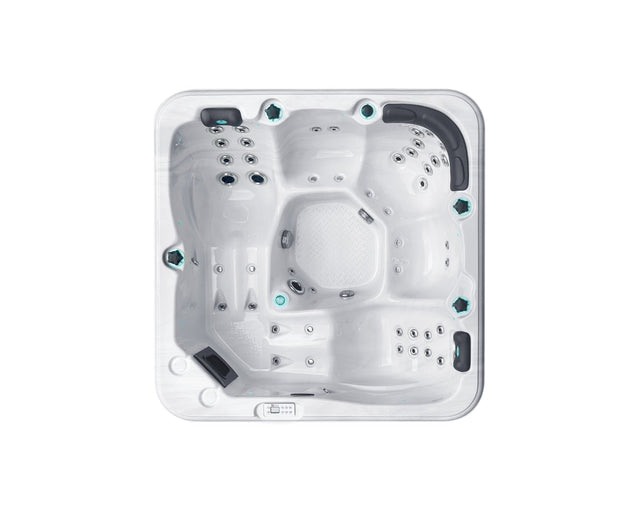
Relax
Frequently asked questions
How many jets should a good hot tub have?
What is the most energy-efficient hot tub?
Should I buy a plug-and-play or 240V hot tub?
How long should a quality hot tub last?
Is it worth buying from a warehouse instead of a dealer?
See every model in person at Fonteyn Houston
Over 30 models on the warehouse floor. Sit in them, run the jets, compare the seats. Our team will walk you through exactly what to look for based on how you plan to use it.